Peptide Purity Resolution Imaginative Peptides-peptide Medicine Exploration
Total Listing Of Verified Peptide Providers With Certificates Using an extremely detoxified peptide minimizes these threats and boosts the integrity of your data. Nevertheless, achieving ultra-high pureness (claim 99%) can be practically tough and might not always be necessary, as we'll go over later. The secret is understanding what level of purity is sufficient for your needs and just how pureness is figured out in the first place. The majority of peptide purity analyses use reversed-phase HPLC (RP-HPLC). In this configuration, the fixed stage is hydrophobic (water-repelling), generally C18-bonded silica. The mobile phase is a gradient of water and an organic solvent like acetonitrile, commonly with a small amount of trifluoroacetic acid (TFA) to develop the heights. Specially customized peptides or cyclic peptide sequences are challenging to confirm, which affects quality assurance.
Validates the exact molecular weight and validates the peptide's identification.
It is a chart with time on the straight axis and detector feedback, normally UV absorbance, on the vertical axis.
Comprehending what the data indicates guides your decisions about the tested item.
Explore flagship study peptides with batch-specific COA documents and HPLC/MS confirmation.
Detailed Peptide Launch & Logical Verification
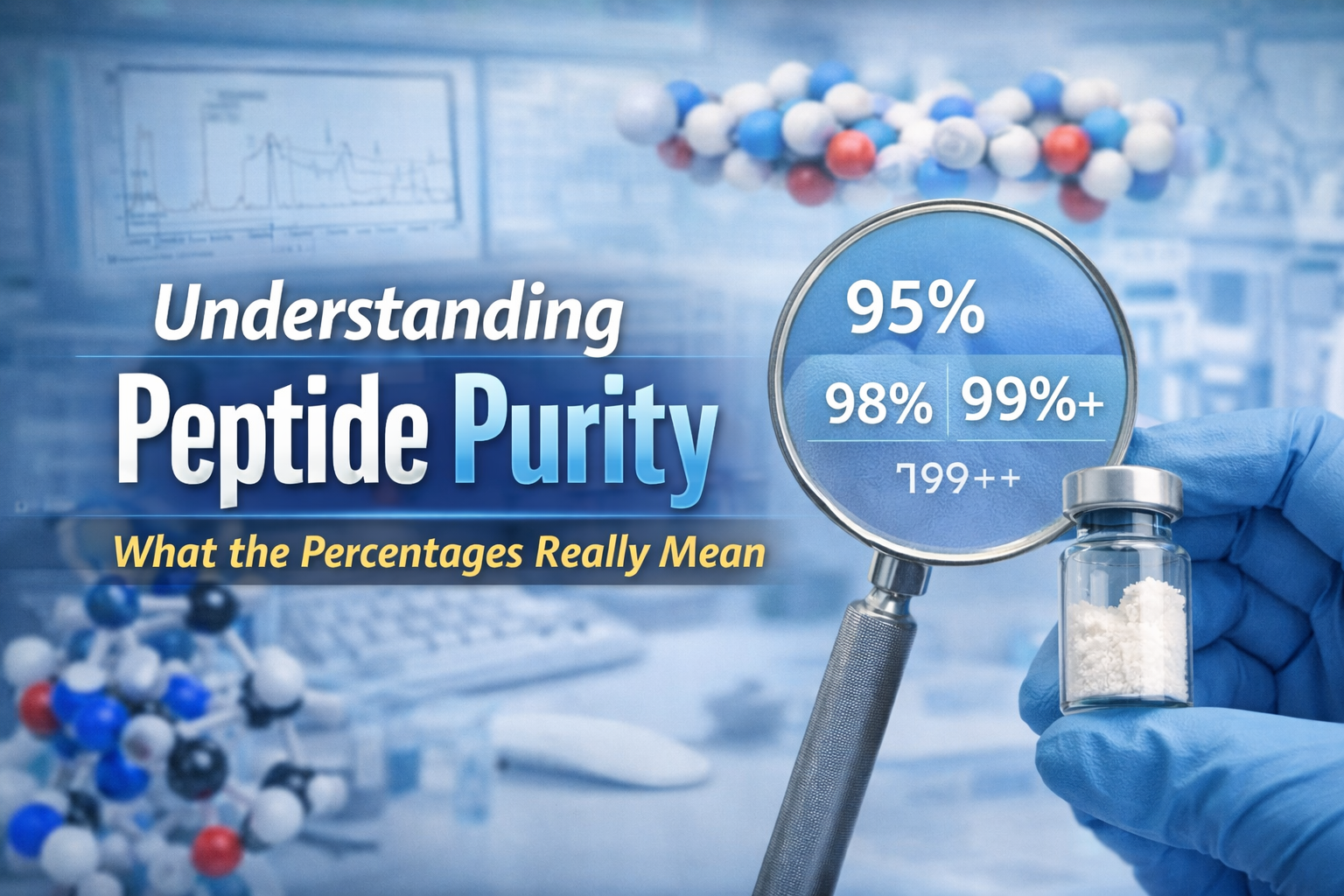
The most strict grade, including cautious HPLC filtration-- occasionally multiple rounds-- and strenuous QC. Needed for measurable research studies, architectural biology, in vivo research study models, and any application where even small amounts of contamination might affect results. This is the grade where the boost most greatly, since attaining that last 1-- 3% of pureness calls for disposing of a substantial fraction of the synthesized material. A functional assay determining downstream signaling-- or an architectural study using NMR or X-ray crystallography-- demands the highest possible pureness offered. Crystallographers particularly commonly need ≥ 98% purity because also small buy SARMs online UK pollutants can avoid crystal formation or present condition right into the crystal latticework. The reproducibility situation in biomedical research study is well-documented. A 95% purity implies that out of every 100 "books" in your set, 95 are excellent duplicates and 5 have some sort of mistake. This overview breaks down what purity actually implies in peptide chemistry, how it's gauged, what the impurities are, and how to check out the paperwork that verifies a peptide is what it claims to be. If you've ever before surfed a peptide brochure, you've seen purity numbers anywhere. These numbers obtain thrown around so commonly that it's easy to gloss over them-- simply another spec on an item web page. Chameleon Peptides offers study compounds exclusively for lab and logical objectives.
Is 95% purity helpful for peptides?
Peptides with an 85% pureness degree or greater are typically utilized in enzyme assays or organic activity research studies. Peptides with pureness above 95% are superb for quantitative evaluation.
Identification Verification Testing
Understanding what peptides are is fundamental understanding, but recognizing how to confirm their quality is what separates successful scientists from those that struggle with inconsistent outcomes. Mass spectrometry (MS) is used to validate the specific molecular weight and molecular identification of the substance, validating the appropriate amino acid sequence and ruling out alternative or structural incongruities. Utilizing mass spectrometry, we confirm the molecular structure and amino acid sequence. This is the only method to ensure that the compound has the right biological activity and is exactly what it declares to be. The software program attracts borders around each top and determines the area beneath.
Thorough Peptide Quality Screening Solutions
Peptide screening is logical confirmation of a peptide example. In COA testimonial, it usually includes HPLC purity testing, mass spectrometry identification confirmation, and batch-specific documentation revealing the evaluated lot, technique, results, and date. With years of analytical testing experience and advanced instrument systems, BOC Sciences supplies comprehensive peptide top quality screening services across the entire process from basic materials to solutions. Third-party laboratory recognition can considerably assist in this compliance process. The resulting information are formatted right into records that regulators anticipate. So, purity isn't simply a number on a certification; it's basic to success. Peptide testing is the logical process made use of to validate that a study peptide is both pure and appropriately identified. HPLC measures chromatographic purity by separating the target peptide from associated impurities and determining main-peak area percent. Mass spectrometry verifies molecular identification by checking whether the gauged mass matches the anticipated peptide mass.